

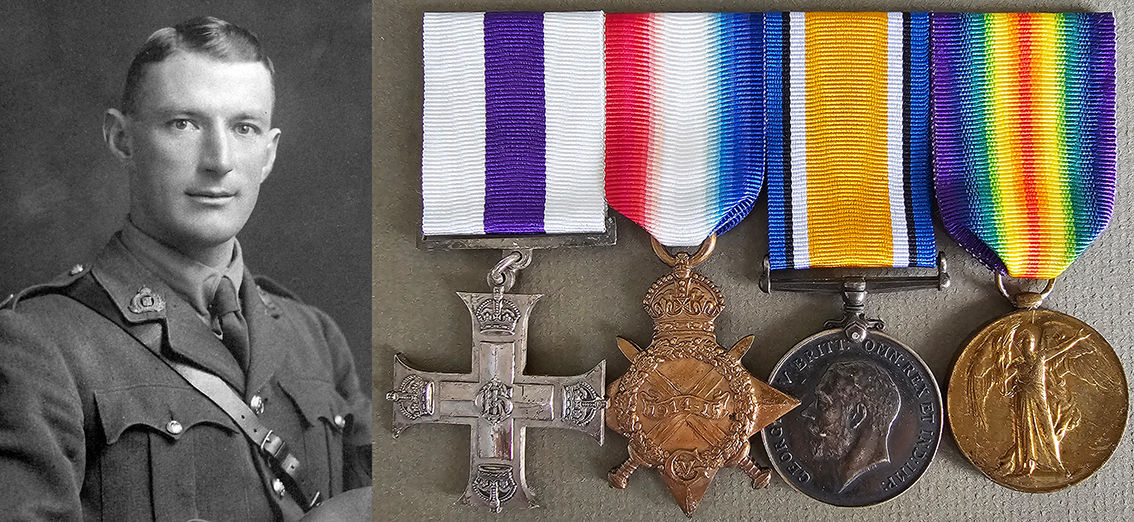

9/1282 Robert Deane Douglass, MC
NZEF MC Group - VC Action - Douglass
The superb Military Cross group to 9/1282 Robert Deane Douglass, who was an eyewitness to the actions for which Sgt D.F. Brown was awarded the Victoria Cross. Douglass later was awarded the Military Cross for gallantry in 1918.
Robert Deane Douglass was born on 14th June 1891 at Oamaru, New Zealand. Son of Robert and Louisa Douglass (née Deane). At the time of his enlistment in the NZEF in 1915 he was working as a farmer at Ardgowan near Oamaru. He embarked with 6th Reinforcements, Otago Mounted Rifles and appears to have served on Gallipoli during the closing stages of the campaign. In April 1916 he transferred to 2nd Battalion, Otago Infantry Regiment and deployed to France.
During the Battle of the Somme in September/October 1916 Douglass was in the thick of the fighting. When the officers of his company were lost during the attack on 15th September, NCOs like Donald Brown, Jesse Rodgers and Robert Douglass took over and lead their men forward to take the objectives - Douglass fighting as a bomber alongside Brown. Brown was conspicuous by his gallantry, which he repeated during the attack on 1st October - this ultimately costing him his life, but was later acknowleged with the award of the Victoria Cross. Robert Douglass himself was commissioned soon after the Somme advance, as was Jesse Rodgers and it was these two men who were instrumental in recommending Brown for the award of the coveted cross. Robert Douglass's recommendation reads:
On the 15th Sept. at 6.20 a.m. the 10th North Otago Coy. advanced, the 2nd line being their first objective. Before this was reached the Company was held up with heavy machine gun fire; all the officers of the Company were at this time out of action. Sergt. Brown, at great personal risk, went forward, working his way from shell crater to shell crater, to a flank, until he got within 50 yards of the gun. He shot the gunner and one of his crew, and then rushed the position. The remainder of the crew retired, leaving the gun in our possession. The brave action of Sergt. Brown enabled the Company to advance and take its first objective.
The Company was again held up in front of the SWITCH TRENCH by machine gun fire; Sergt. Brown again worked his way to the flank and entered the trench unobserved at a point where the parapet had been blown in. He reached the strong point and disposed of the crew of the gun. In clearing this trench of the enemy Sergt. Brown did splendid work with his bayonet.
After the position had been consolidated 80 yards in front of the SWITCH TRENCH, the men had to stand to all the afternoon under an intense bombardment by the enemy. Sergt. Brown, by his remarkable spirit, and his utter contempt for danger did much to keep up the spirit of the men.
On the 1st October Sergt. Brown was again conspicuous for his leadership and the gallantry and coolness he displayed. On this occasion he again put out of action the crew of a machine gun, crossing the trench to the right of the position and attacking the crew from behind. He was killed 50 yards in advance of this post while sniping at the retreating enemy.
In August 1917, following the wounding and subsequent death of Jesse Rodgers MC MM, Douglass was promoted to temp. captain to replace him. In August 1918 he was wounded by a gas shell, returning to his unit on 10th September 1918. On the night of 29th/30th September Douglass was conspicuous by his bravery in leading his platoon in establishing a bridgehead over the Canal de l'Escaut in the heart of the Hindenburg Line. The recommendation for the subsequent award of the Military Cross reads:
For conspicuous gallantry and devotion to duty during operations near Vaucelles on the night of 29th-30th September 1918. He took his platoon forward to reconnoitre the canal and bridgehead. Though twice driven back by direct rifle and machine-gun fire, he worked his way round and occupied the bridgehead, a distance of 1,000 yards, in the dark, which could never have been done by daylight.
After the war Douglass married and worked as an accountant at Mangatoki near Eltham before retiring to Napier. He died in Whangarei on 23rd November 1971.
The Military Cross has been privately engraved LIEUT. R.D. DOUGLASS 2 BOR NZEF. The 1914/15 Star and Victory Medal are correctly impressed 9/1282 LIEUT. R.D. DOUGLASS. N.Z.E.F.. The BWM is unnamed.
Also with the groups is Douglass's Gallipoli Lapel Badge, Large RSA Badge, dog tag, Gallipoli Medallion issue certificate and Somme commemorative badge.